
A friend of mine has a 2005 PX 150, a fairly rare scooter in the US. In fact, his was one of the very first brought in for that one-year-only scooter here in the States. That doesn't mean much though, since those first 600 scoots got some fairly basic "upgrades" like a special metallic green paint, brown seat, and a small badge with the "limited edition Serie America" number. The PX's are great, and since there are only a small handful in the US (a few thousand at best), it is really worth seeking one out. In any case, my friend bought this used, with super low miles on it... but it just never ran well. Eventually, he got tired of trying to make it run right, and brought it by for a thorough going over.
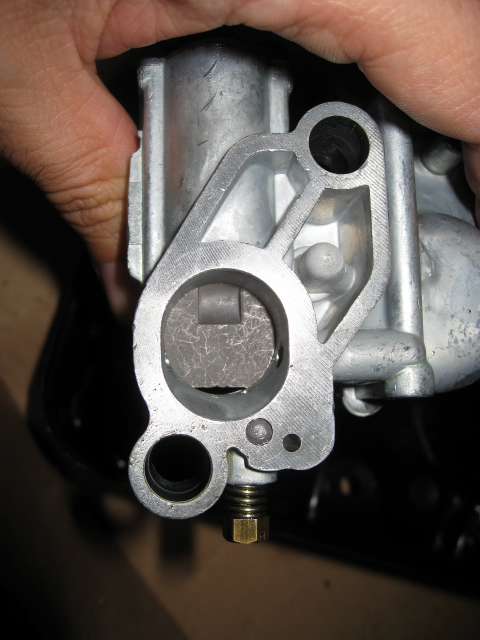
The first thing I did, was take off the carb to clean it, and check for anything strange. I immediately noticed that there was a problem. As you know, the PX's have oil injection. There is a special carb that works with the injection system. If you look at the photo above, you see the bottom of the carb. There is a small hole at the bottom right of the carb. That is the hole that the two stroke oil goes through on its way to be mixed with the gas. We like that hole, because it means we don't have to mix the oil with the gas ourselves. I've seen people disconnect the automatic oil injector because they don't trust it.. I find that silly.
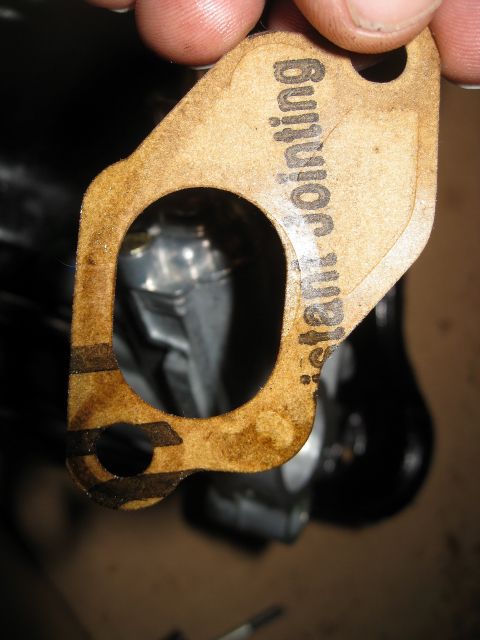
Now here we see the carb base gasket. Notice anything? There is a small impression on the bottom right where that hole in the carb sits. Note that there is no corresponding hole in the gasket. This means that the oil injector was blocked off, and no oil was getting into the cylinder. Yowch! You can buy carb base gaskets for oil injected carbs, and non-oil injected carbs. It is pretty important that you don't use a non-injected gasket on an injected carb.
Click below the jump to see what happens with no oil!
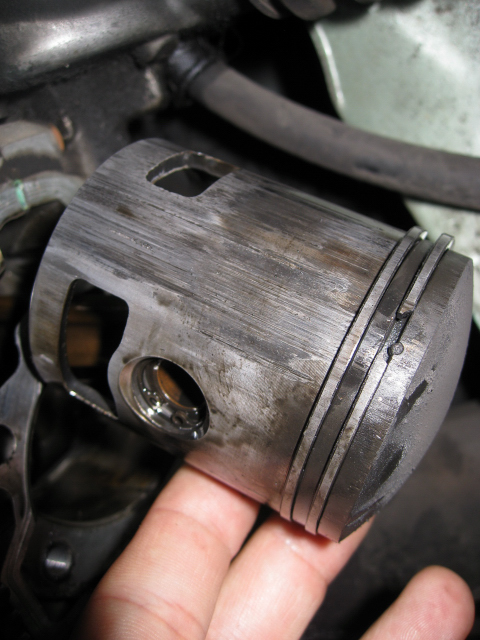
So, with the knowledge that this sucker was not getting any oil. I knew I had to take off the cylinder to see what the piston looked like. I removed the exhaust, the cylinder shroud, and the cylinder head (remove the nuts slowly in a "X" pattern, a 1/2 turn each nut). If you want to get the cylinder off with the motor still in the scooter, you need to also remove the studs, which I did. When I got the cylinder of, the piston looked pretty bad, as you can see in the photo above. Lots of scoring on the sides means the compression was shot. It is interesting to note that this scooter still ran like this, it was just a bit on the slow side. In any case, it was time to replace this mess with something that will work. I got a 160cc top end, which I have previously used on my beater P125 to great success. I also needed to get a special DR cylinder head to match. With the parts in hand, I had to do some work to make everything match up.
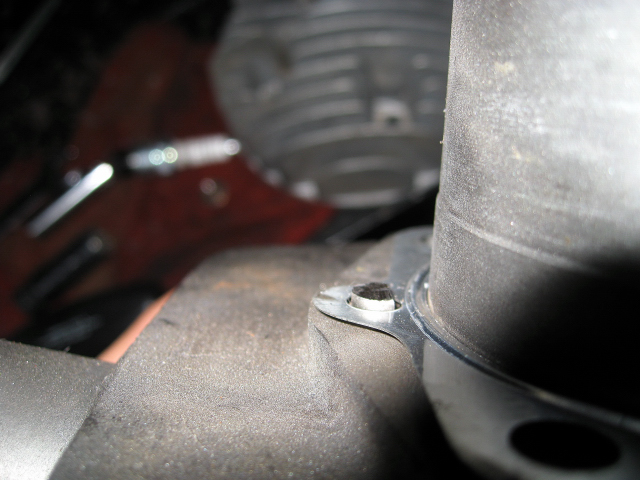
When I used this top end in the past, I realized that it just didn't mate up correctly with my cases. I realized that this little locating pin on the bottom of the cylinder was not placed correctly. In order to make it work, I took a Dremel tool and shaved some material off the pin. I cut it down so it was shorter in depth just a bit, and then I cut down the inner diameter of the pin, as you can see in the photo above. I would cut a bit of material off, then test the fit, and continue until it mated up with the case correctly. I didn't want to take too much material off, because this pin serves an important purpose of aligning the cylinder correctly with the case.
Stay tuned for Part 2 in our next installment!
I'm sure it didn't come from the factory like that. I'm not sure who put that in, it could have been the dealer. New Vespa dealers have no idea about how these vintage scooters work. It could also have been the previous owner. At this point, nothing could be done except fix it, and move on.