
More information than you ever wanted to know about LD Lambrettas....
Courtesy of Steve Jackson, Leicester, UK
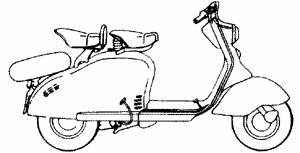 The very first LDs appeared about 1953, and were little more than D types with covers added. They were all 125cc, and the engines retained some of the primitive features of the earlier C and LC types, such as:
- The crankshaft ran on 4 separate ball bearings, both the flywheel side bearings being lubricated by the petroil mixture.
- The crankshaft was made in two halves, the web on the flywheel side being fitted with a pinchbolt, which was fully tightened once the crank was in place, before the barrel and piston were fitted. The big end bearing consisted of separate, replaceable, needle rollers - there was no cage to retain them, as on later models
- The small end bush/piston pin were 14mm diameter.
Other primitive features included the lack of a cable-operated choke for the carburettor - there was a hinged flap on the right hand side panel, through which the choke slide was operated. This meant that the rider had to stop the machine to disengage the choke once the engine had warmed up! I believe the float chamber was fitted with a spring-loader plunger (known as a "tickler") which allowed flooding of the carburettor for starting in really cold weather - all very messy!
These machines had the push/pull gear selection as on the C/LC, and although they had the same torsion bar rear suspension as the later LDs, there was no rear shock absorber. There was no separate ignition coil on these machines, the high tension winding being wound on top of the low tension ignition winding on the stator plate. This system might have worked fine in the Italian climate, but it was a real disaster in the much wetter climate of the UK!
There was also an electric start version, which retained the same ignition system, and had a separate 6 volt battery. This powered the lights as well, and was charged from the single lighting coil on the stator plate, fitted with a full wave rectifier. To compensate for the limited amount of electrical power available, I believe these had only a 15 watt headlight.
I guess these machines are classified as Mk1s, as their external appearance is almost identical to the later versions.
About 1955, the first Ld150 Mk 1appeared, and I believe that the Ld125 was brought up to a similar specification. These had the usual one-piece crankshaft (fitted with two double-row ball bearings), conventional magneto ignition with separate HT coil, two separate cables for the gearchange, and were fitted with a rear shock absorber/damper. The small end bearing was still only 14mm diameter, and self-starter machines became 12 volt.
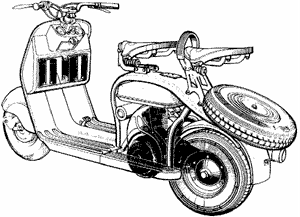 At engine number 127815, the small end bearing was changed to the usual 16mm diameter, and at engine number 143580, alterations were made to the shock absorber mounting on the transmission case, and to the mounting on the frame.
This was because the original mounting on the transmission case was semi-recessed, and there had been problems with the aluminium castings. There were lots of detail changes made on these models, but none were very significant.
After engine number 214637, the Mark 2 was introduced. This had the larger (epicyclic) kickstarter, with a different engine casting to suit. The carburettor air filter was connected via a rubber hose to an air box in the frame, with the air inlet on top of the frame, behind the fuel filler.
(I'm not sure when changes were made to the cylinder porting, but the first Mk1 150s had a rectangular exhaust port, and a small inlet port. Later machines, including all Mk3s, had an oval exhaust port, and an inlet port which was about 3 mm deeper.)
After engine number 221140, the Mark 3 was introduced, with the covered handlebar. This had the advantage of an illuminated speedometer, so the rider could see just how slowly he was travelling after dark!
As far as I know the only significant difference between the 125 and 150 machines after about 1955 was that the Mk3 125s had a different final drive ratio, in an attempt to get the best performance from the 5bhp available. These used a 12 to 45 pinion/crownwheel ratio, instead of the usual 13 to 45.
Your performance figures are about right - I have an Innocenti booklet (Instructions to Repair Shops) for the Mark 3. This claims about 47mph for the 125, and about 50mph for the 150. My experience is that an unmodified Mk3 150 will achieve a steady 50mph on the flat, in calm conditions. I did modify a Mk3 150 to improve performance many years ago - by making minor changes to the porting, increasing the compression ratio to about 7.5:1, and fitting a free-flowing exhaust box (a so-called "sports silencer"). This would cruise at about 50mph, with a top speed in the region of 55 to 60 on a good day.
I have no further details about the imported French Mk4 machines, except that all those I have seen were 125s, and contained many parts which were non-interchangeable.
One comment about the handling of the machines - the main problem is that the suspension is too soft - they were designed for low speed travel over poor road surfaces, and not for higher speed travel. It is possible to increase the preload of the torsion bar to stiffen the rear suspension, and to fit Li springs to the front, provided they are cut or ground to the same length as the originals. The solution my brother and myself devised was to fit Li forks, handlebars and front wheel, but that's another story....