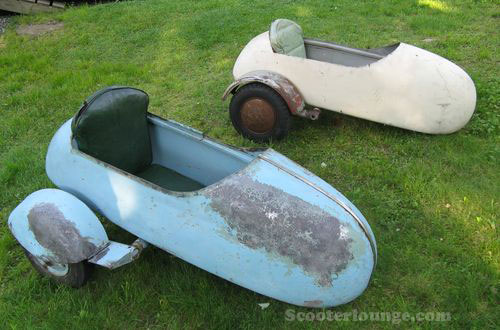
Here's something I don't think too many vintage scooter fans have seen before: two different vintage Meyers Aircraft sidecars (Vespa models) compared side by side.
The history of steel-bodied scooter sidecars manufactured in America is kind of sketchy, but from what I've learned, a company called Meyers Aircraft in Georgia built steel-bodied sidecars for various motorscooters starting in the mid/late 1950s and into the mid 1960s. We've seen these on Vespas, Lambrettas, and Harley Toppers; they were probably available for other brands too, it's just not easy to find pictures or documentation on anything other than those three marques. The two shown here are both Vespa models; the early blue one is for 1950's widebodies, the later white one is for 1960's largeframes.
(Continued below the jump)
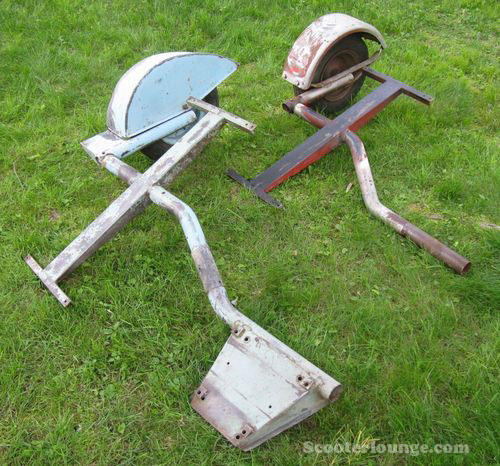
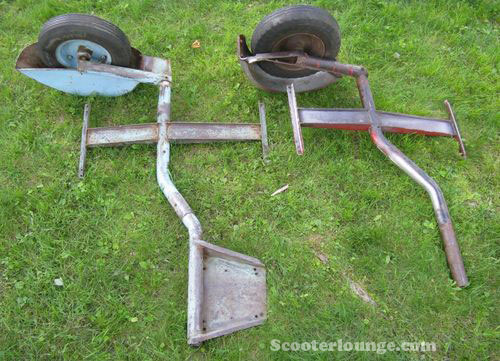
The Meyers Aircraft body tubs were pretty much identical, made from two steel halves welded together lengthwise in the center with an aluminum trim strip covering he weld seam on the top side. The chassis were made of round tube and used a simple torsion bar suspension. Compare pictures of Harley Toppers with sidecars with these Vespa models and you can see they're the same body tub, and very similar chassis.
What's interesting is the fact that the earlier models of these Meyers sidecars had a teardrop fender, and the later style had a basic trailer-type fender, exposing the tire. When the opportunity to compare one of each came up, out came the camera. Take a look; check out the differences.
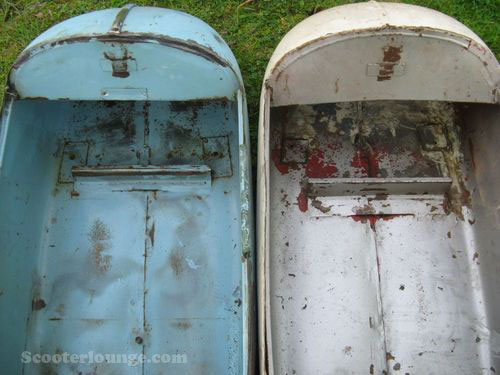
The blue one is the earlier one with teardrop fender, the white/silver one is the later one.
Note the trim strip covering the weld seam on the blue tub - the white one acquired some body filler over the seam at some point in its life.
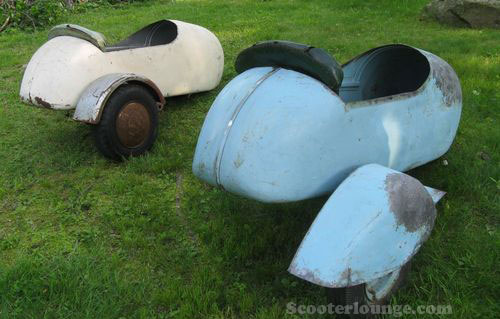
Of big interest on the earlier one is the integral bracket for mounting to a Vespa widebody frame - there's a slip joint just past the first bend in the chassis tube. The later model has a separate bracket which mounts independently to the scooter.
The teardrop fender is hinged at the front, the later model is just bolted solid on both ends.
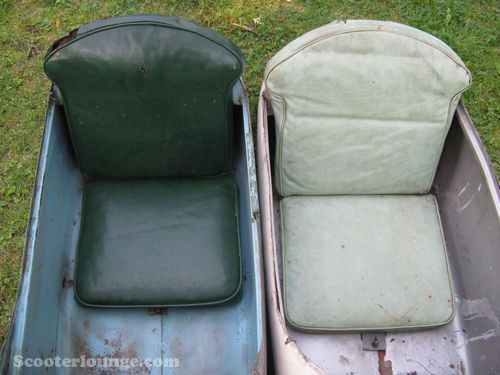
Dig the seats: plywood frames upholstered with vinyl, over jute padding. More comfortable than they look.
Removing the seats reveals the brackets for the seats. The blue (early) sidecar was sold through Sears, and has an Allstate Cruisaire badge screwed below the top seat bracket holder.
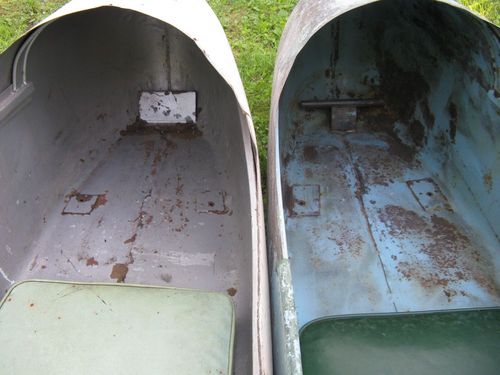
Footwells compared: later model (left) has a flat footrest, the early model on the right has a T-shaped footrest. Two of the four mounting holes are visible along with the precisely placed (ahem) reinforcing plates.
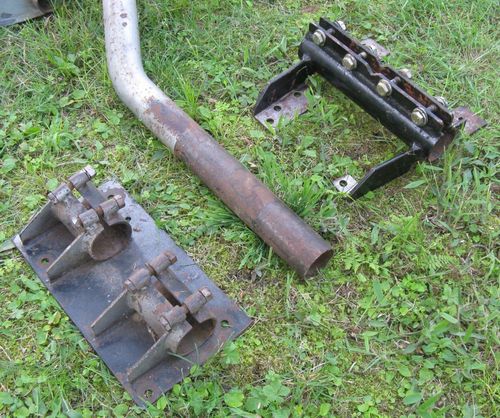
Special bonus pic #1: two styles of Vespa mounting brackets for the later style sidecar. I haven't confirmed what the rectangular one on the left is for, but the one on the right fits typical Vespa largeframes.
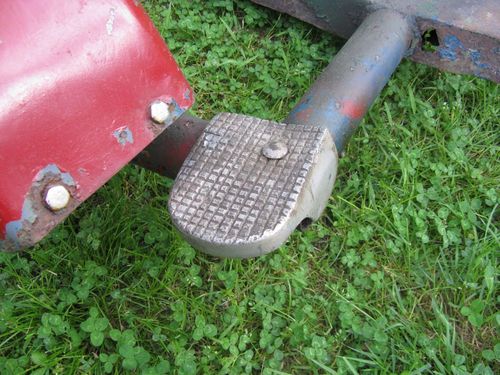
Special bonus pic #2: closeup of the cool aluminum waffle-pattern step from the later-style Meyers sidecar chassis. These are often missing or damaged.