
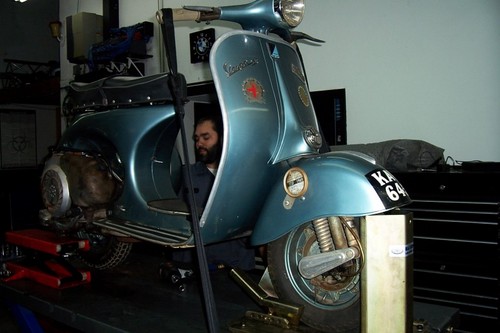
One nice thing about living in the San Francisco Bay Area is that there is a critical mass of people who are into collecting odd-ball vehicles. Whatever strange and obsolete brand you can name, there is likely a club here that is dedicated to preserving it. The thing that I like most about the vintage vehicle culture here is that a lot of the enthusiasts actually drive their stuff regularly. There is so much around, that organizers of events have to carefully delineate who can attend so as not to be overwhelmed. Not only that, but the area is a magnet for very rare models of cars and motorcycles. It is indeed, an embaressment of riches!
With that in mind, I'm not all that surprised when a scooter turns up locally that is ultra-rare, and ultra-interesting.
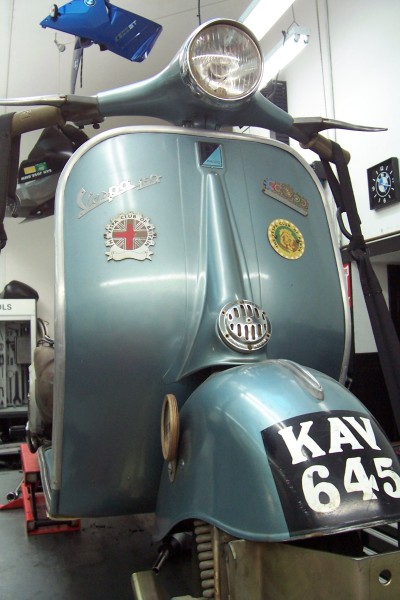 Case in point - a friend of mine who is very into scooters, and old vehicles in general, works for a local BMW and Vespa dealer. Since they sell new Vespas, occasionally someone will show up with a vintage scooter. In this case, someone brought in a scooter that was pretty strange. It is an early Vespa G.L. These were basically just Vespa VBA's with 10" wheels. They were not sold in the US, and not sold in Italy, but were available in certain other markets. For instance, in Germany they were sold as the Vespa "Touring."
In any case, this particular scooter was extra-interesting due to its provenance and its condition. First, as you can see from the pictures, it is in excellent condition. No dings, no dents, and no rust. It appears to have its original paint. This clearly was a scooter that has been well loved by its owner. 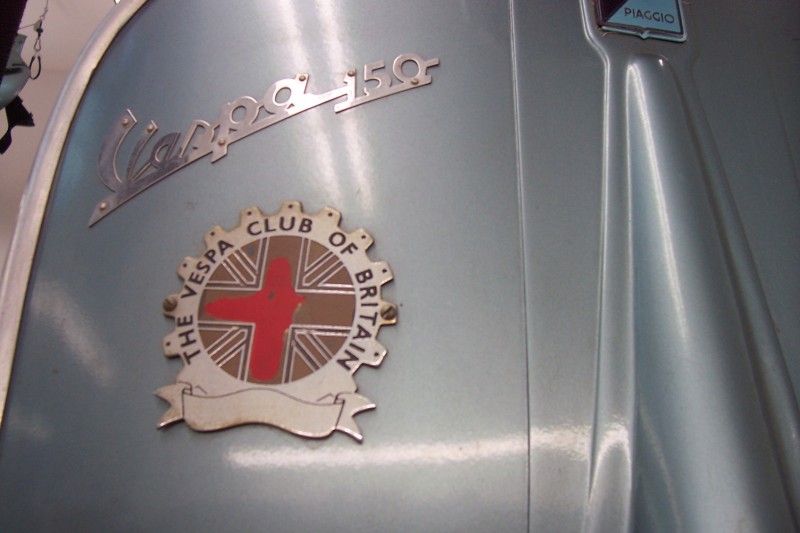 However, the thing that sets this scooter out from all the rest is its history. In particular, the history as told by the badges affixed to the legshields. In the 50's and 60's, there used to be a very active scooter culture which was centered on official Vespa clubs. I suppose that isn't a whole lot different than today, except now we are more loosely organized. Nevertheless, these official clubs spanned the globe. One thing they had in common were these metal badges. National clubs had special badges, and local clubs made them as well. In Europe, the badges were especially popular, and local clubs would make special memorial badges for their rallies to give out to participants. Scooterists would show off the badges they had obtained either on the front of their scooter, or on specially made "badge bars" which were bolted to the legshields on special occasions.
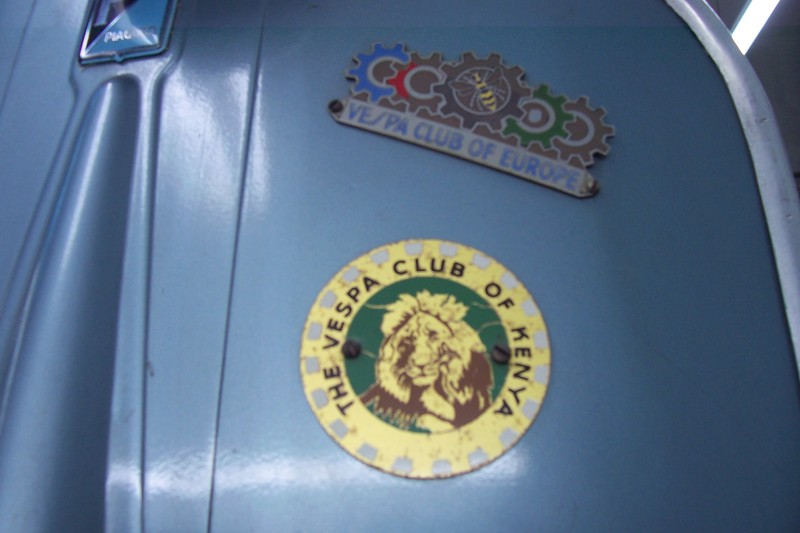 This scooter has a few of these badges. You can see the Vespa Club UK badge, and the Vespa Club of Europe badge. Those are pretty common. The one that caught my eye was the Vespa Club of Kenya badge. Now THAT is one you don't see every day. I can't imagine that many of that badge were ever made, the old VC Kenya couldn't have had many members. There are quite a few people in Europe that collect the old metal badges, and I bet that many of them never even knew this one existed. I would not be surprised if the badge alone was worth as much as the scooter if offered to the right collector! (ed. note: ok, maybe that is a bit of hyperbole, but the badge is worth a lot!)