
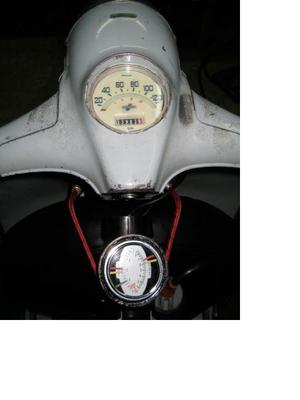
One thing about vintage scooters that is appealing to me is that they were meant to be economical transportation, yet a lot of thought went into style and design. When you normally think of budget vehicles, you don't normally think of them as "beautiful". On the other hand, being made as cheaply as possible didn't leave room for a lot of creature comforts or even technical accessories that are quite useful, but could drive up the price. Note that only the most basic gauges were provided - a speedometer and odometer. No gas gauge, no volt meter, no temperature gauge, etc.
Well, here we are in the 21st Century, and still driving these things. They are no longer budget vehicles, but collectors' items... albeit collectors' items that we still drive and enjoy. I don't do a lot of tuning these days, at least not much more than really minor stuff like cylinder upgrades. However, there are a lot of people who like to take vintage scooters to the limit. One of them, is my friend Patrick, who has spent a lot of time thinking about how to make his highly tuned scooters become reliable long-term runners. He's made the coast-to-coast Cannonball Run rally on a very tuned Vespa, and done the grueling Moto Melee on a tuned Vespa, and a stock Lambretta.
He's recently put a post up on his site detailing how he installed an exhaust temperature gauge and a cylinder head temperature gauge on his TV 175 Series II Lambretta. Not only does he describe where he put the temp probes, but he also explained how he reads them and where the "danger zone" is for temperature on a vintage two stroke. Great stuff! Go and read the article here.